
By Hazel Scott/ASU
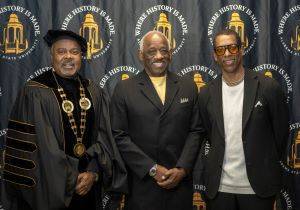
On the crisp morning of February 6, 2026, the Dunn-Oliver Acadome at Alabama State University buzzed with excitement. Students, faculty, and guests gathered at 10 a.m. for the 126th Founders’ Day Ceremony, eager to hear from keynote speaker Orlando Jones—a groundbreaking writer, actor, producer, and cultural innovator whose work has helped shape television, film, and digital media for more than 30 years.
From his early days as the face of the iconic “Make 7 Up Yours” campaign to being a founding writer and original cast member of the influential sketch comedy show “MADtv,” Orlando’s creative spirit has caused him to stand out. He doesn’t just act; he has crafted stories, voiced characters in animated productions and video games like “Halo 2” and “King of the Hill,” and helped launch the FX Network as the host of “Sound FX.” His diverse roles—from playing the African god Anansi in Starz’s “American Gods” to appearances in “Abbott Elementary,” “Swagger” and “Drumline”—have showcased his powerful presence and cultural resonance.
As the Founders’ Day ceremony unfolded, Jones reflected on his multifaceted career. He spoke of challenges, creativity, and the importance of innovation in education and life. His voice carried the weight of experience, inspiring the crowd with a mixture of humor, poignant anecdotes and wisdom gained by tearing down walls and breaking barriers.
His powerful message seemed to resonant with his audience. Much of his comments were directed toward the hundreds of students who listened attentively. He described education as a road that connects lives and leads to successful futures. Jones discussed how, in Marion, Alabama, 159 years ago, nine formerly enslaved men (ASU’s founders) stood together with a single purpose: to build a road away from dirt and hardship.
“This wasn’t a road of asphalt and signs, but one made of education. Alabama State University began small—no fancy buildings, no rich sponsors—just a shared dream that education could be the pathway to a better life. Today, as we celebrate Founders’ Day, we remember that road. It’s not just a symbol; it’s a lifeline. Like roads that connect neighborhoods and cities, education connects generations,” noted Jones. “Education is like a road – when the road is there, everything moves.”
Jones encouraged students to take action even before asking for help. He used the analogy of a woman at a bustling train station dragging a heavy trunk, sometimes slow and struggling, but never stopping. She moved forward, and soon strangers joined to help carry the burden. He said they were motivated by her effort, not by pleas for assistance.
Jones said the Founders’ Day story isn’t just about history; it is a call to action.
“Students, faculty, alumni and staff—keep moving, sweating, struggling, because motion draws help, and help turns effort into opportunity. Thanks to those nine pioneers and to those who keep dragging their trunks today, the road goes on, leading us all into futures worth fighting for,” he explained.
Jones spoke about his famous movie, “Drumline,” explaining how it tells the story of unity and strength. "Behind one band, one sound," he said, "when we come together, we are stronger and can achieve tremendous things."
He reminded the crowd that ignoring where we come from—our past and the lessons behind us—can lead to struggles and failure. But embracing those roots helps us find the resources we need, often close to home.
After his speech, Jones introduced his father, John, a proud ASU alumnus, and his mother, Mattie.
“When I say this place works, I’m not guessing. The education my father got here walked into my house. It showed up at the dinner table, in how bills got paid, in how problems got handled. That’s what roads do. They don’t stop at campus. They lead home,” he added.
Jones shared how his parents encouraged him to be proud of who he is, to believe in himself, and never to shy away from being a nerd. He said that foundation gave him the confidence to stand tall and keep pushing forward, no matter the obstacles.
As the ceremony drew to a close, ASU President, Dr. Quinton T. Ross., Jr., reflected on the enduring values that shaped the University—leadership, service, resilience, integrity, and pride—values born from the vision of nine formerly enslaved men who founded the institution for generations yet to come. Ross spoke of the power of education to lift families and communities, recalling how his parents and Jones’s father had walked the same campus decades ago, fueling the dreams of their children.
Ross commended Jones for a dynamic message that seemed to ignite a spark and issue a call “to dream boldly, unite courageously, and move forward together.”
SPECIAL AWARDS
The convocation continued with four special presentations – the Spirit of Marion Award, the Spirit of Tullibody Award, the Gold Standard Award, and the Community Stewardship Award.
The Spirit of Marion Award winner is alumna Cubie Ray Hayes. The Spirit of Marion Award recognizes individuals whose professional efforts have created innovation, positive change or notable advancement in an industry, environment or concept. Like the Marion Nine, the recipient of this award must demonstrate great vision, honorable citizenship and success in the face of challenge.
Hayes exemplifies the spirit of the award through her lifelong commitment to service, advocacy and community leadership. Hayes has consistently worked to uplift individuals and families across the Montgomery community and throughout the River Region. As a student, Hayes was a dancer with the Mighty Marching Hornets, setting the stage for what would become The Stingettes. Hayes’s extensive and diverse professional career was marked by laudable “firsts,” including being the first female on-air announcer for WXVI radio station.
The recipient of the Spirit of Tullibody Award is Dr. Joseph S. Henderson. The Spirit of Tullibody Award is in honor of Dr. William Burns Paterson, ASU’s longest-serving president, who is revered as a brave and forward-thinking pioneer. The Tullibody Award honors alumni who exemplify Dr. Paterson’s estimable qualities by making notable contributions to their communities and to Alabama State University.
Henderson exemplifies the values, leadership, and lifelong dedication to education and service that defined Dr. Paterson. Henderson has made his mark as an all-around athlete, serviceman in the Korean War, educator, church deacon, and nationally known athletic coach. He is a dedicated supporter of his alma mater, primarily through his work with the Rocket City (Huntsville) Chapter of the National Alumni Association.
This year’s Gold Standard Awardee is Antoinette Campbell, assistant registrar and degree systems auditor at Alabama State University. The Gold Standard Award recognizes a staff or faculty member whose commitment to exceptional customer service advances institutional excellence and fosters a culture of quality across the University. Recipients demonstrate authenticity, empathy, and active listening in every interaction, value diverse perspectives, and consistently exceed expectations while modeling service-centered values aligned with the University’s mission.
Campbell approaches her work with integrity, diligence, and a servant’s heart—values rooted in her Baptist faith and reflected in her commitment to accuracy, accountability, and service, values aligning with the University’s mission and commitment to continuous improvement. Campbell has been a member of ASU’s staff for the past 17 years.
The Community Stewardship Award recipient is Alabama State Sen. Bobby Singleton. The Community Stewardship Award recognizes an individual or community partner/organization whose philanthropic support advances academic excellence and strengthens the University’s continued success. Honorees create lasting opportunities for ASU students through meaningful contributions, including gifts made within the last fiscal year in support of the ASU Cares Retention Scholarship.
An ASU alumnus, Singleton’s lifelong dedication to public service and his unwavering support for his alma mater, Alabama State University, make him an ideal selection for the award. As the state senate minority leader, he has consistently championed educational equity and workforce development, ensuring that students in underserved communities have the resources they need to thrive. His leadership in legislative reform and community advocacy embodies the Hornet spirit of stewardship, making a lasting impact on both the University and the state of Alabama.